
Research
Modeling Solid-Electrolyte Interphase Formation
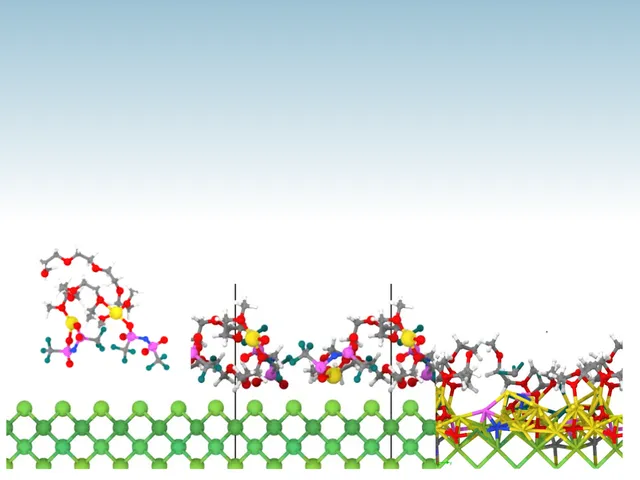
What happens in a battery near its anode? Electrolyte (which is supposed to be electronically insulated) reacts with electrons from Li0 metal and decomposes. This decomposition reaction changes the composition of system near anode, from electrolytes own molecules to a hybrid mixture of several Li-salts, aka solid-electrolyte interphase (SEI) -- a nanoscale layer. Long-timescale (>100 ps) ab initio molecular dynamics (DFT-MD) trajectories capture sequential anion degradation and reaction pathways that are not visible at shorter timescales, providing a comprehensive atomistic picture of SEI initiation on Li(100) surfaces in glyme-based electrolytes (ChemPhysChem 2026, full-text).
Nanoconfined Water Microenvironments & Ionic Equilibria
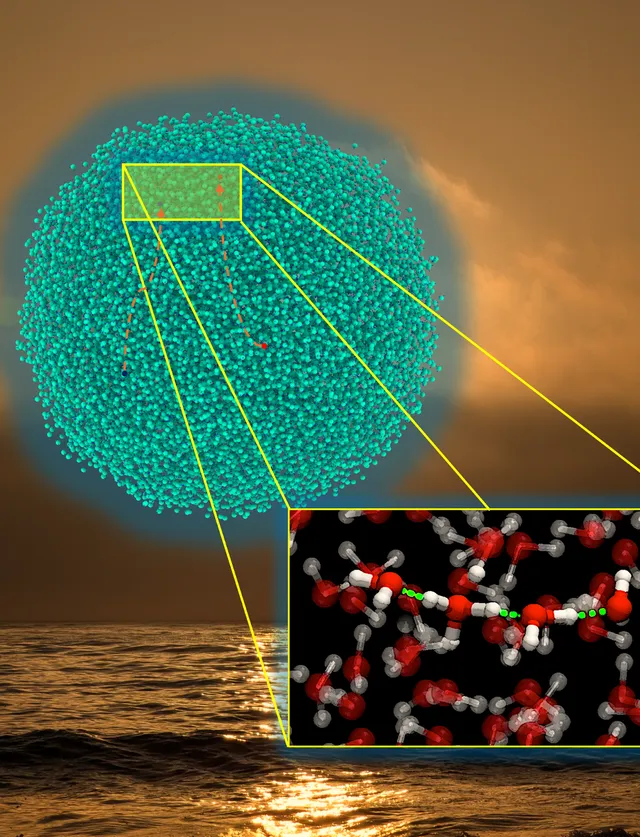
Aqueous chemistry inside nanoscale droplets and confined microenvironments differs substantially from bulk solution. Using multiscale molecular dynamics and free-energy simulations, we investigate the recombination of autodissociated hydronium (H₃O⁺) and hydroxide (OH⁻) ions in pure water nanodroplets (JACS 2025, 147, 8, 6583–6593) as well as bicarbonate–carbonic acid proton-transfer equilibria at confined interfaces.
Soft-Solid & Co-Crystalline Battery Electrolytes
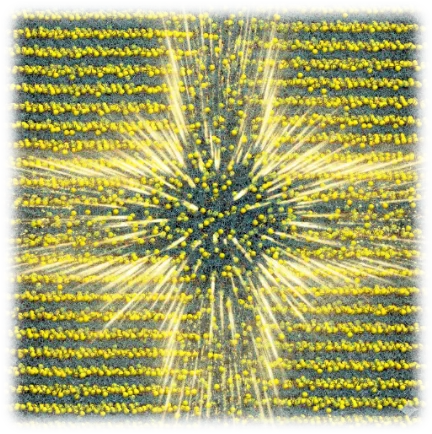
Co-crystalline and solvate-sponge solid electrolytes combine the safety and mechanical stability of crystalline solids with the favorable interfacial contact and alkali-ion transport of liquid electrolytes. Our molecular dynamics and DFT investigations elucidate the structural and dynamical complexities, surface melting, and ion-conduction channels in lithium and sodium co-crystals (Nature Materials 2023; Chemistry of Materials 2025).
Photocatalytic CO2 Conversion & Carbon Capture
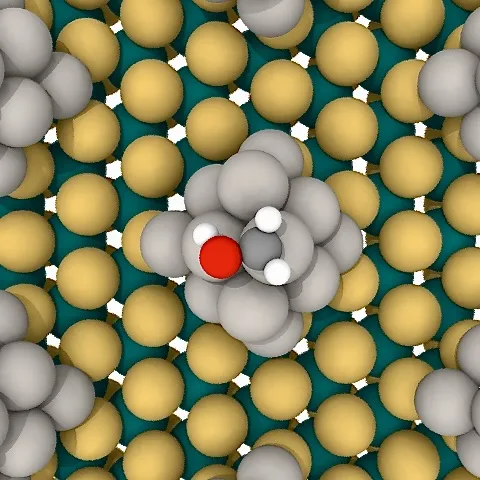
Multi-sun illumination enhances photocatalytic CO2 methanation activity via increased charge carrier density and rapid CH4 desorption. First-principles DFT calculations reveal a *CHO-mediated reaction pathway with reduced energy barriers enabled by dual-cocatalyst interfaces (Applied Catalysis B 2026). This direction is somewhat a new vertical on my previous experience of working with CO2 physisorption in amino-acid ionic liquids during PhD.
Computation Automation and Workflows
How do we handle many calculations that differ because of the chemical and physical complexity of a system? One example is deriving expansion adiabats for high-energy materials. Another is finding adsorption sites on hybrid surfaces, especially for reactions that lead to multi-carbon (C2+) products, where the number of possible intermediates and binding configurations grows quickly. I developed general-purpose condensed-phase simulation workflows to set up, run, and analyze such problems. One of them screens adsorption sites with a machine-learned interatomic potential (MACE), refines the best candidates with DFT, and builds free-energy diagrams using the computational hydrogen electrode (CHE). Some of these scripts are available on request.
For simple, first calculations, especially for new students, the tools need to be easy to reach. So I merged scripts I have written over the years into a single modeling, visualization, and analysis tool — Drsta.
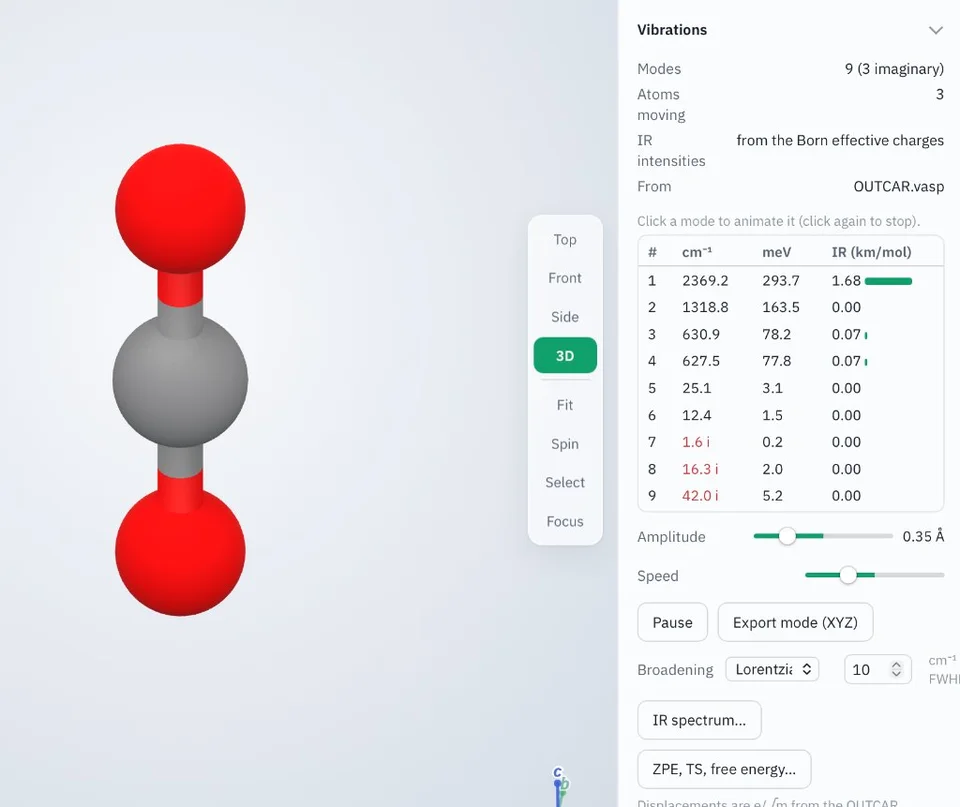
Automatic Code Detection & VASP Vibrational/Electronic Analysis
Automatically detects inputs, outputs, and trajectory frames from VASP, GROMACS, LAMMPS, Quantum ESPRESSO, and CP2K. For VASP, it parses vibrational modes directly from OUTCAR to animate normal modes and compute ZPE, vibrational entropy, free-energy corrections, IR spectra, DOS, and band structures.
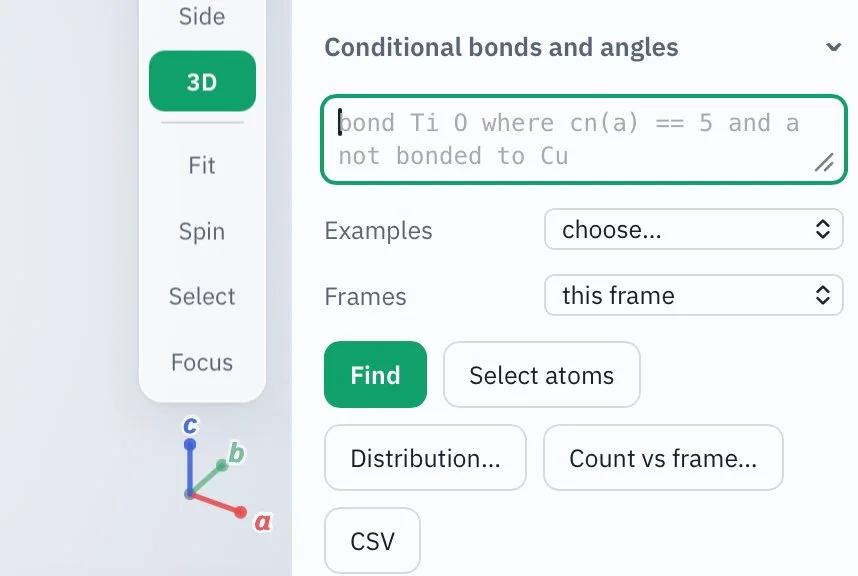
Conditional Bond & Angle Analysis
Filter and analyze coordination environments across single frames or full trajectories using expressive queries (e.g., bond Ti O where cn(a) == 5 and a not bonded to Cu), with instant atom selection, distributions, frame-by-frame counts, and CSV export.
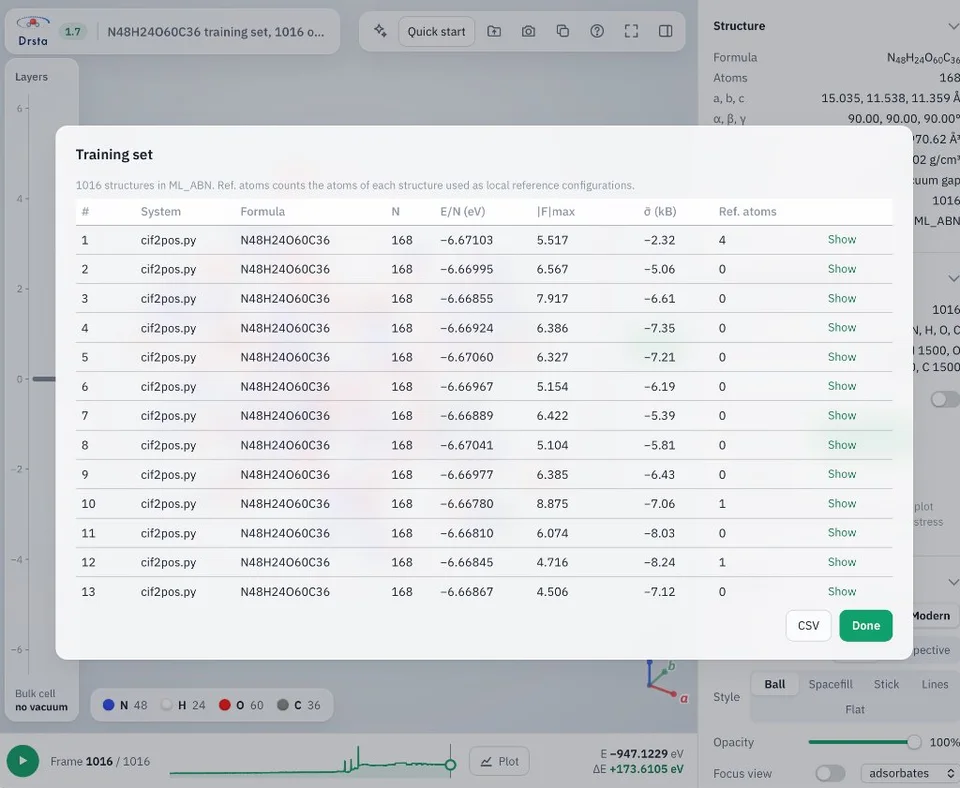
Direct VASP ML_AB / ML_ABN Active-Learning Inspection
Opens VASP machine-learning force-field files (ML_AB / ML_ABN) directly to inspect selected configurations, per-atom energies, maximum forces, stress, and local reference atoms, alongside an interactive energy trace that highlights sparsification and outlier training frames.
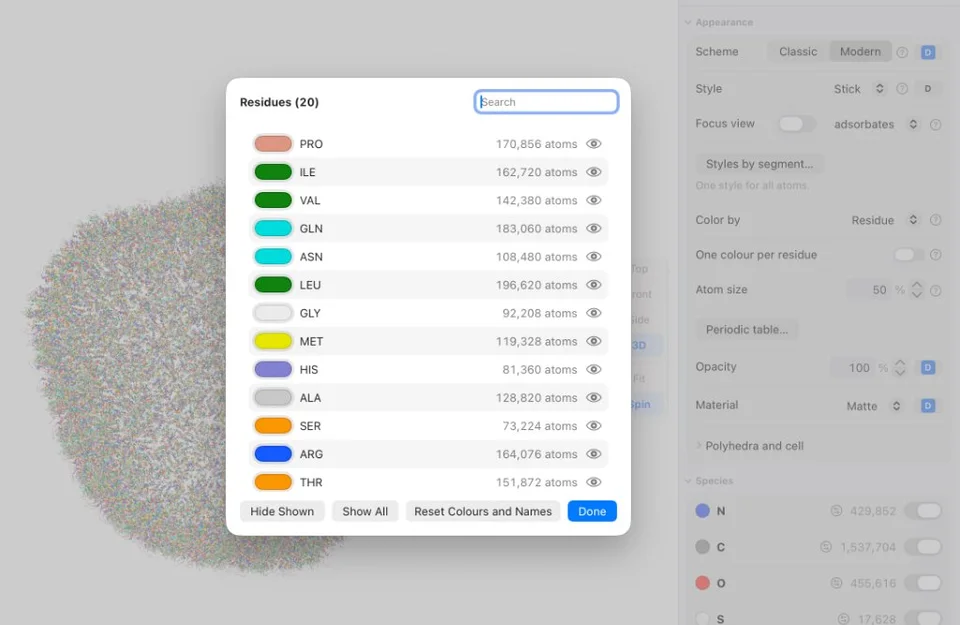
Multi-Million-Atom Browser Rendering (HIV-1 Capsid, PDB 3J3Q)
HIV-1 capsid (~2.4 million atoms, ~240 MB) color-coded by residue type and rendered in the browser on an M4 MacBook Pro — loading in ~5 s with smooth interactive rotation and zooming.
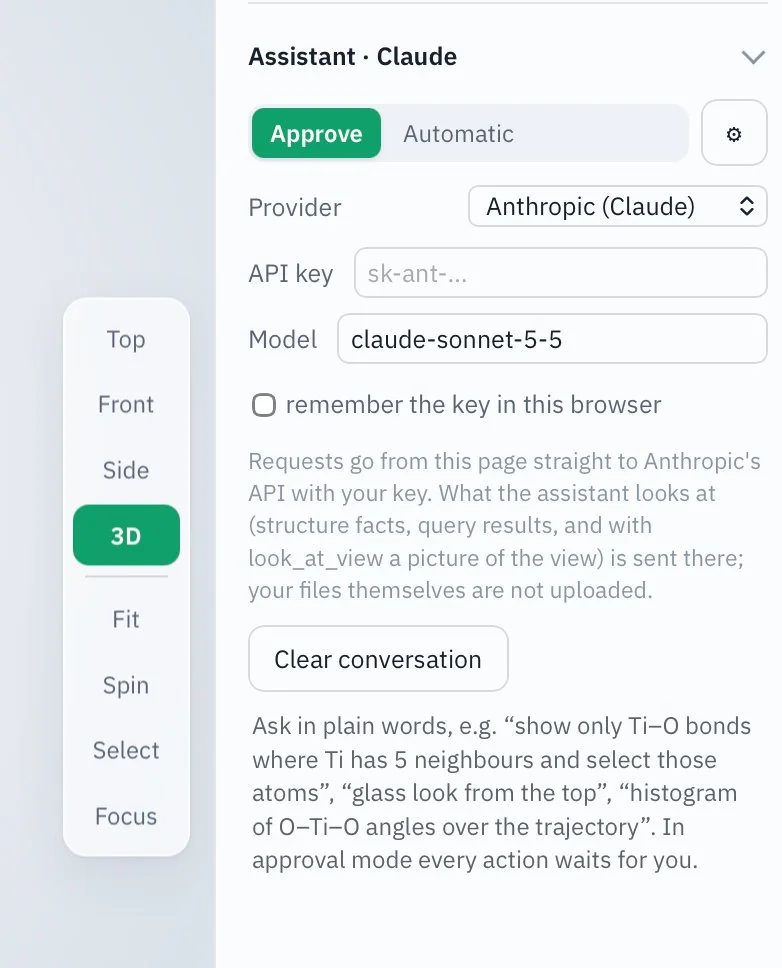
In-Browser Natural-Language AI Assistant
Ask for scene changes or structural queries in plain English using your own API key from Google Gemini, Anthropic (Claude), or OpenAI. Supports both frontier models and fast, low-cost models like Claude Sonnet and Gemini Flash (so you don’t burn heavy tokens just asking “rotate it by 30 degrees!”).
Drsta runs in a web browser on any laptop, with nothing to install. It renders with WebGPU where the browser supports it and falls back to WebGL2 otherwise. Your files are read and processed locally on your own computer; they are not uploaded anywhere. Drsta can:
- open outputs and trajectories from VASP, LAMMPS, CP2K, Quantum ESPRESSO, ORCA, and GROMACS, as well as common formats such as PDB, CIF, XYZ, Gaussian Cube, and
CHGCAR; - analyze structures and trajectories: radial distribution functions, diffusion (MSD), clusters, and bond and angle statistics with conditional queries (for example, all Ag–O bonds where Ag is not bonded to Cu);
- build and edit structures and write input files for VASP, Quantum ESPRESSO, CP2K, and LAMMPS;
- produce publication-quality figures and plots;
- optionally take instructions in plain language through an AI assistant, using your own API key (Anthropic, Google Gemini, or OpenAI).
Try it at ppt-2.github.io/drsta, and see the Quick-Start Guide to get going.
Drsta is also available as a Python package (.whl) for servers and HPC nodes. It displays structures interactively in Jupyter notebooks, writes standalone HTML views, renders figures in batch without a display, and significantly reduces token consumption when integrated into AI-assisted CLI analysis and visualization workflows. The package is available to interested users on request.